
Twin screw pumps are positive-displacement pumps used in food processing, pharmaceuticals, chemical manufacturing, oil and gas, and other industries. They transfer fluids through chambers formed by two rotating screws. For industrial applications, choosing a reliable twin screw pump manufacturer in India can help ensure suitable pump selection and reliable fluid transfer.
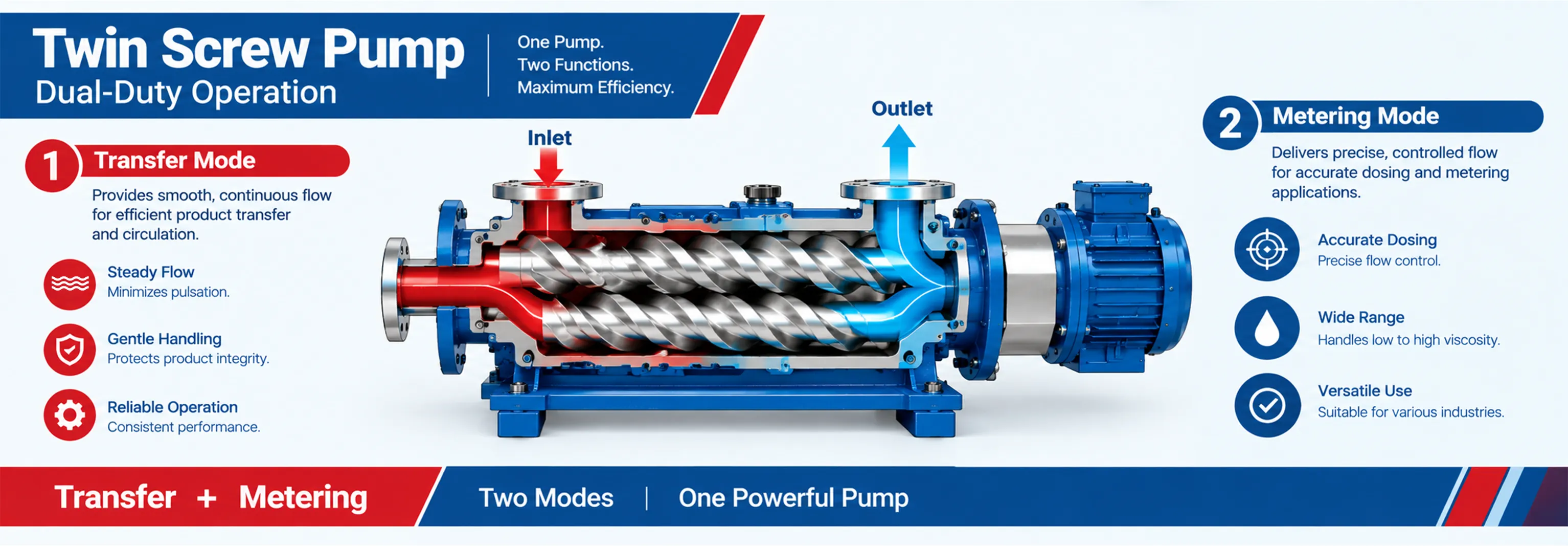
Understanding how twin screw pumps work involves screw rotation, fluid movement, screw geometry, and operating conditions. Some hygienic models also support dual-duty operation for product transfer and cleaning-in-place (CIP). Learn more about the differences in design, performance, and applications in our guide to lobe vs. twin screw pumps.
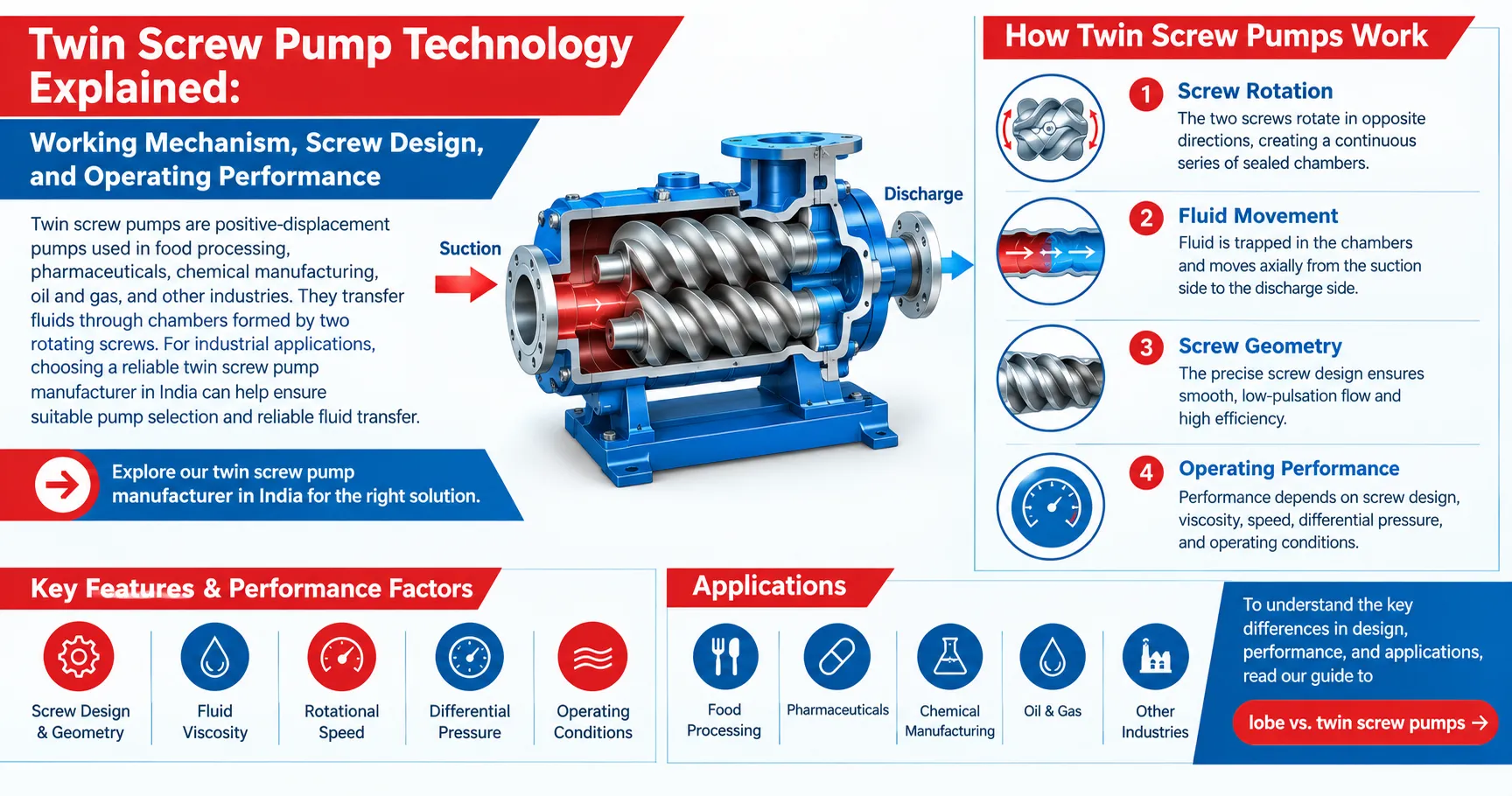
Understanding the Twin Screw Pump Working Principle
Main Components and Their FunctionsA typical twin screw pump contains two rotating screws inside a casing. In timed designs, gears maintain the required relationship between the screws.
| Component | Function |
|---|---|
| Driving screw | Receives power from the motor |
| Driven screw | Rotates in synchronisation |
| Pump casing | Forms the fluid passage |
| Timing gears | Maintain screw synchronisation in timed designs |
| Suction inlet | Allows fluid to enter |
| Discharge outlet | Directs fluid into the system |
| Bearings and seals | Support shafts and help prevent leakage |
The motor rotates the driving screw, which synchronises with the second screw. The screw threads and casing form chambers that carry fluid from suction to discharge. In many timed designs, the screws do not contact each other during normal operation.
From Suction Inlet to Discharge OutletThe pumping cycle involves four stages:
- 1. Fluid entry: Fluid enters through the suction inlet.
- 2. Chamber formation: Rotating screws form fluid-filled spaces.
- 3. Axial transport: Chambers move fluid along the screw axis.
- 4. Discharge: Fluid exits through the outlet.
Successive chambers support continuous fluid delivery. Actual flow depends on displacement, speed, viscosity, pressure difference, suction conditions, and internal leakage.
Twin Screw Pump Fluid Dynamics: What Happens Inside the Casing?
Fluid Movement Through the Screw ChambersThe screw profiles and casing form chambers that transport fluid along the pump. Their geometry influences displacement, chamber filling, and flow performance.
The Effects of Viscosity, Speed, and PressureViscosity and operating conditions affect leakage, flow resistance, and power requirements.
| Operating factor | Possible effect |
|---|---|
| Higher viscosity | Increased flow resistance and power demand |
| Lower viscosity | Potentially greater internal leakage |
| Higher speed | Increased theoretical flow but possible suction limitations |
| Higher differential pressure | May increase leakage and power requirements |
| Restricted suction | Reduced chamber filling and flow |
| Worn components | Increased leakage and reduced efficiency |
Internal leakage, or slip, occurs when fluid moves through clearances towards a lower-pressure region instead of reaching the outlet. This reduces volumetric efficiency.
Actual flow ≈ Theoretical displacement flow − Volumetric losses
Compare measured flow with manufacturer data under actual operating conditions.
How Suction Conditions Influence Pump PerformanceRestricted suction can reduce chamber filling and cause low flow, noise, or unstable operation.
To improve suction performance:
- Use correctly sized suction pipes.
- Minimise unnecessary bends and restrictions.
- Keep filters and strainers clean.
- Check fluid temperature and viscosity.
- Ensure adequate liquid supply and suction pressure.
- Select a suitable pump speed.
Twin Screw Pump Screw Geometry and Its Impact on Flow
Screw Pitch, Profile, and Chamber VolumeScrew geometry includes thread shape, pitch, and the spaces formed between the screws and casing. These features influence displacement, fluid transport, efficiency, and application suitability.
How Screw Design Affects Flow Rate and PressureTheoretical flow depends on displacement per revolution and rotational speed. Actual delivery also depends on leakage, chamber filling, and operating conditions.
Consider the following when selecting a pump:
- Required flow and differential pressure.
- Fluid viscosity and temperature.
- Available suction pressure.
- Speed and power requirements.
- Product compatibility and cleaning requirements.
- Manufacturer operating limits.
Clearances allow screw rotation while limiting leakage. In timed designs, correct alignment helps maintain the required screw relationship.
| Condition | Potential consequence | Recommended action |
|---|---|---|
| Excessive clearance | Increased leakage and reduced flow | Check manufacturer specifications |
| Insufficient clearance | Contact and damage risk | Verify assembly and tolerances |
| Incorrect alignment | Noise and wear | Arrange qualified inspection |
| Bearing wear | Shaft movement and clearance changes | Inspect bearings |
| Damaged screw surfaces | Reduced performance | Assess before restarting |
Clearance Guidelines: Clearance values depend on the pump model, materials, temperature, and operating conditions. Always follow manufacturer specifications.
Excessive clearances can increase leakage, while insufficient clearances can cause contact as components move or expand. Correct alignment and specified clearances support reliable operation.
Twin Screw Pump Dual-Duty Operation: Product Transfer and CIP
Switching Between Product Handling and CleaningSome hygienic twin screw pumps support dual-duty operation, handling product transfer and cleaning-in-place (CIP). This may reduce equipment requirements, but dual-duty capability must be confirmed for the specific model.
Managing Different Fluid Viscosities and Flow RatesProduct and cleaning fluids may require different operating conditions. Verify:
- Approved speed and flow for each duty.
- Required differential pressure.
- Fluid temperature and material compatibility.
- Seal and elastomer compatibility.
- Cleaning procedures and hygiene requirements.
- Manufacturer operating limits.
CIP effectiveness depends on cleaning solution, temperature, flow, contact time, system design, and validated procedures. A CIP-capable pump alone does not guarantee that the entire system is clean.
| Potential benefit | Important consideration |
|---|---|
| One pump for product and cleaning | Model must support both duties |
| Reduced equipment requirements | Confirm capacity for each duty |
| Flexible operation | Settings may need adjustment |
| Simplified cleaning arrangements | Validate the cleaning process |
| Easier changeovers | Prevent cross-contamination |
Common Twin Screw Pump Performance Problems
Low flow may result from suction restrictions, unsuitable speed, excessive leakage, wear, or incorrect operating conditions.
- Compare measured flow with the expected value.
- Check suction pressure and restrictions.
- Verify viscosity and temperature.
- Confirm speed and differential pressure.
- Inspect internal components when necessary.
- Compare results with manufacturer data.
Possible causes include suction problems, air ingress, cavitation, misalignment, bearing wear, mechanical contact, or excessive load. Investigate hydraulic and mechanical causes rather than assuming one fault.
Undersized pipework, blocked strainers, high viscosity, and excessive speed can prevent adequate chamber filling. Inspect the suction system before increasing speed.
Wear can increase clearances and leakage, reducing efficiency. Incorrect assembly and bearing damage may also affect alignment. If mechanical contact or damage is suspected, isolate the pump and arrange a qualified inspection.
Twin Screw Pump Troubleshooting and Maintenance
Checking Suction and Discharge Conditions- Check suction and discharge pressure.
- Measure delivered flow.
- Verify fluid type, viscosity, and temperature.
- Inspect suction pipes, valves, and strainers.
- Confirm speed and motor load.
- Review recent process changes.
Follow manufacturer procedures to inspect screw surfaces, clearances, bearings, seals, shafts, and timing components where fitted. Stop operation if severe vibration, contact, or damage is suspected.
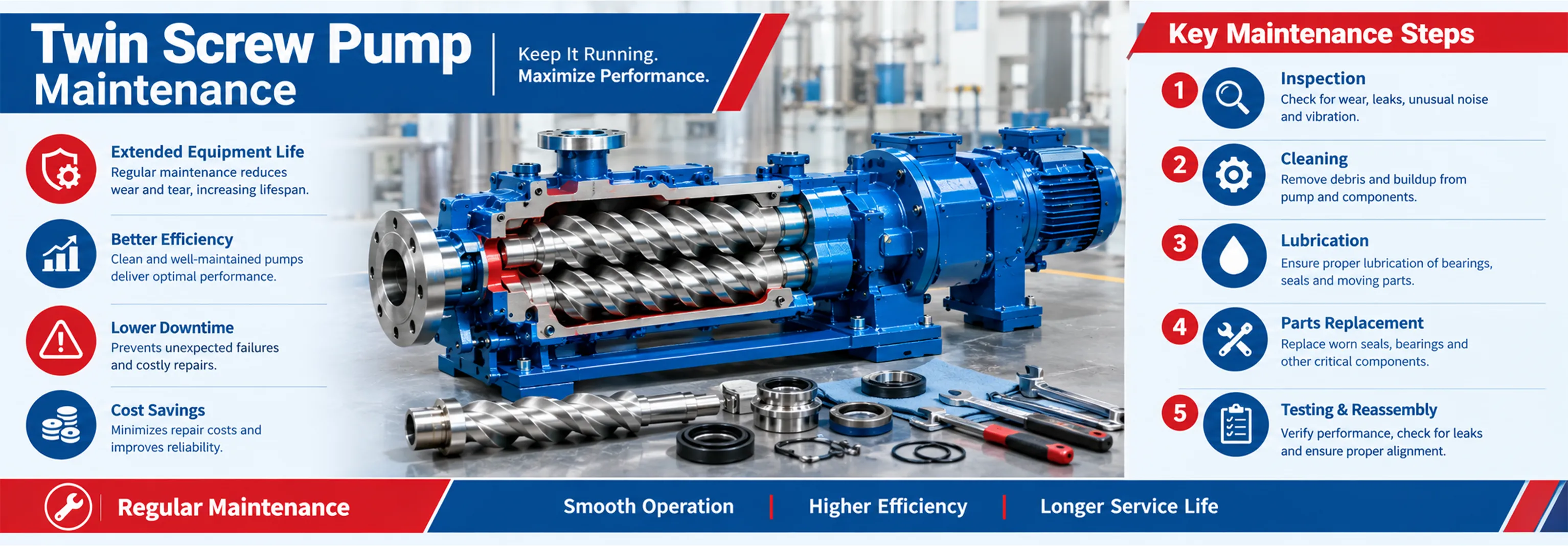
Record flow, pressure, temperature, vibration, and motor load over time. Compare measurements taken under similar conditions to identify performance changes.
Preventive Maintenance for Longer Pump Life- Follow the manufacturer's maintenance schedule.
- Inspect seals, bearings, screws, and clearances.
- Monitor noise, vibration, and leakage.
- Check alignment and timing components when required.
- Keep the suction system clean.
- Record operating measurements and maintenance findings.
How to Select a Twin Screw Pump for Your Application
Matching Pump Design to Fluid PropertiesChoose a pump based on fluid viscosity, temperature, required flow, pressure, and product sensitivity. Different screw designs suit different operating conditions.
Determining Required Flow, Pressure, and SpeedConsider:
- Required flow and differential pressure.
- Minimum and maximum viscosity.
- Fluid and cleaning temperatures.
- Suction conditions and pipework.
- Motor power and operating speed.
- Duty cycle and maintenance access.
For dual-duty applications, confirm that the exact model supports product transfer and CIP. Check cleaning performance, materials, seals, flow requirements, and operating limits.
Using Manufacturer Specifications for Pump SelectionUse manufacturer performance curves and technical specifications to confirm flow, power, and operating range. Avoid selecting a pump that must operate beyond its recommended limits.
Frequently Asked Questions About Twin Screw Pumps
-
How Do Twin Screw Pumps Work?
Two rotating screws transport fluid through chambers formed inside the casing, moving it from suction to discharge.
-
What Is the Twin Screw Pump Working Principle?
The pump uses positive displacement to move fluid through successive chambers formed by rotating screws.
-
What Affects Twin Screw Pump Flow Rate?
Flow depends on displacement, speed, viscosity, differential pressure, suction conditions, clearances, and wear.
-
Why Is Screw Geometry Important?
Screw pitch and profile influence chamber volume, displacement, fluid transport, and performance.
-
Can Twin Screw Pumps Handle High-Viscosity Fluids?
Many models can handle viscous liquids, depending on screw design, speed, suction pressure, and power requirements.
-
What Is Twin Screw Pump Dual-Duty Operation?
It allows a suitably designed pump to handle product transfer and cleaning fluids, such as CIP solutions.
-
What Causes Low Flow or Excessive Noise?
Possible causes include suction restrictions, air ingress, unsuitable speed, internal leakage, misalignment, bearing wear, or mechanical contact.
-
How Can Pump Performance Problems Be Reduced?
Use correct pump selection, maintain suitable suction conditions, operate within specified limits, and follow preventive maintenance procedures.
Key Factors Behind Efficient Twin Screw Pump Operation
The Relationship Between Screw Design and Fluid DynamicsScrew geometry, chamber volume, viscosity, clearances, and operating conditions determine how effectively fluid moves through the pump.
Maintaining Performance Through Correct Selection and MaintenanceReliable operation requires suitable pump selection, adequate suction conditions, performance monitoring, and manufacturer-recommended maintenance.
Summary Table: Twin Screw Pump Design and Performance| Key factor | Role in operation | Importance |
|---|---|---|
| Screw geometry | Determines chamber shape and displacement | Influences flow |
| Fluid dynamics | Describes fluid movement | Explains flow and pressure |
| Viscosity | Affects resistance and leakage | Influences efficiency and power |
| Internal clearances | Allow rotation and limit leakage | Affect reliability |
| Dual-duty capability | Supports product and cleaning duties in approved designs | May reduce equipment needs |
| Suction conditions | Influence chamber filling | Help maintain flow |
| Preventive maintenance | Identifies wear and changes | Supports service life |
Understanding the twin screw pump working principle helps engineers select suitable equipment, troubleshoot performance issues, and plan maintenance. Correct screw geometry, appropriate operating conditions, and verified dual-duty capability support reliable industrial fluid handling.