
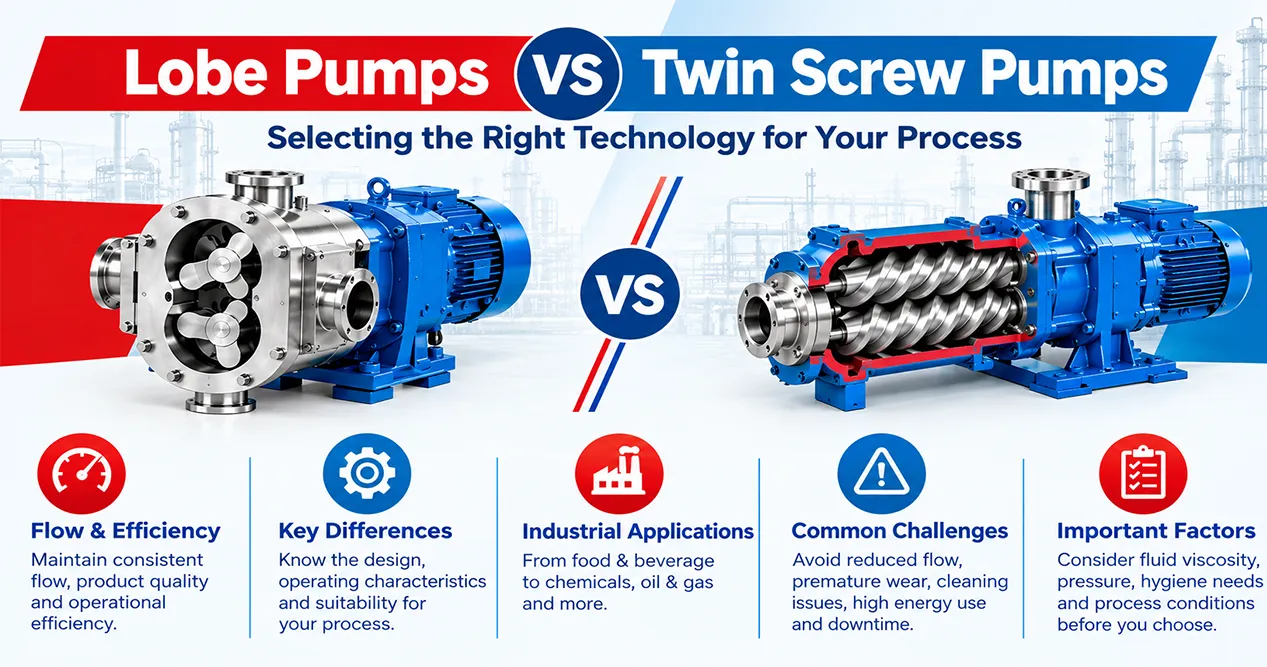
Choosing the right industrial pump is essential for maintaining flow consistency, product quality, operational efficiency, and equipment reliability. Selecting the wrong pump can lead to reduced flow, premature wear, difficult cleaning, increased energy consumption, and costly downtime.
Lobe pumps and twin screw pumps are both positive-displacement technologies used in industrial fluid transfer. However, their designs, operating characteristics, and suitability vary according to fluid viscosity, pressure, hygiene requirements, and process conditions. Understanding how lobe pump works and the twin screw works principle can help engineers compare their performance and select the right solution. Businesses looking for suitable equipment can explore a lobe pump manufacturer in India or a twin screw pump manufacturer in India.
This guide compares rotary lobe vs. twin screw pumps, their industrial applications, common operating challenges, and the factors engineers should consider before selecting a pumping solution.
What Is a Lobe Pump?
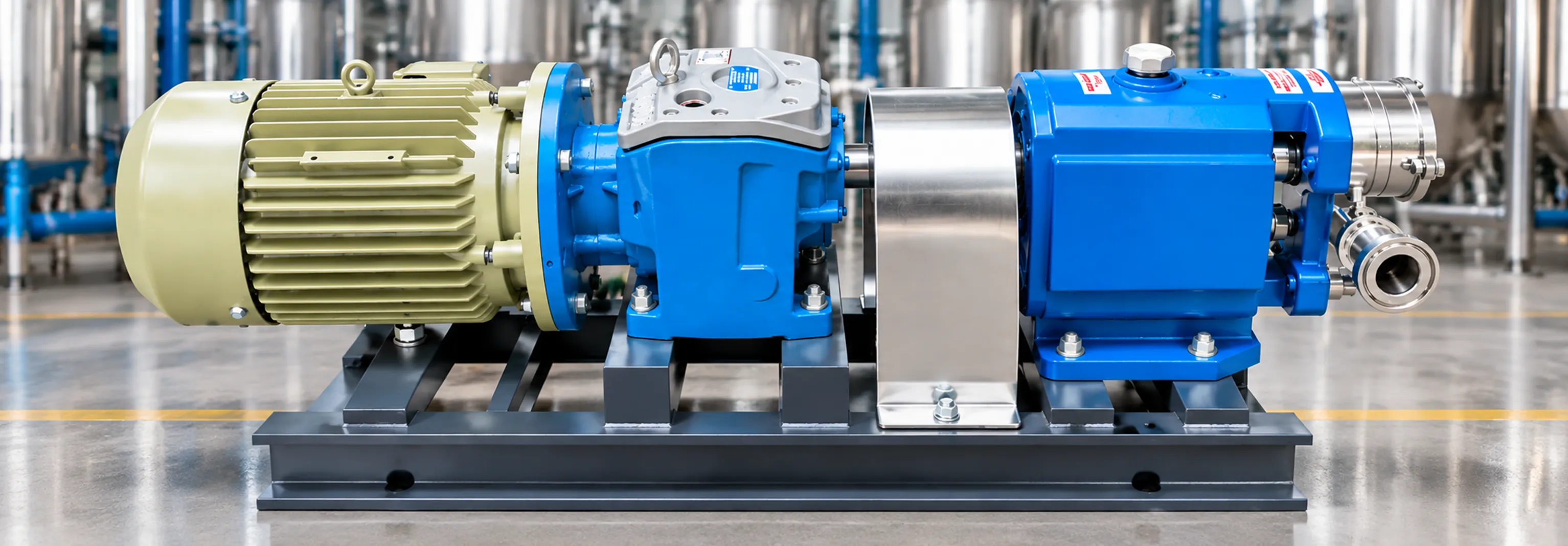
A rotary lobe pump is a positive-displacement pump that uses rotating lobed rotors to transfer fluid from the inlet to the discharge. Timing gears synchronize the rotors, allowing them to move fluid without contacting each other in typical designs. Learn more about the lobe pump working principle in our guide on how lobe pumps work, and explore lobe pump solutions from Stephen Pumps for industrial fluid-handling applications.
Lobe pumps are widely used for viscous liquids and selected fluids containing suspended solids. Performance depends on rotor design, speed, clearances, viscosity, and differential pressure.
How Does a Lobe Pump Work?- Rotating lobes create cavities that draw fluid into the pump.
- The cavities transport fluid around the casing.
- Fluid exits through the discharge as the cavities decrease in volume.
- Actual flow depends on pump speed, internal slip, fluid properties, and system conditions.
- Handles many viscous and shear-sensitive fluids.
- Suitable for selected solids-containing products.
- Reversible flow is available in appropriately designed models.
- Hygienic lobe pumps can support sanitary processing when designed for the required standards.
- Some designs provide convenient access for inspection and maintenance.
Typical applications: Food and beverage, dairy, pharmaceuticals, cosmetics, chemicals, and selected wastewater processes.
What Is a Twin Screw Pump?
A twin screw pump uses two synchronized helical screws to move fluid axially through a pump housing. It is a positive-displacement technology often considered for applications requiring smooth flow or flexibility across different process conditions. Learn more about the twin screw pump working principle and explore industrial twin screw pumps from Stephenson Pumps to understand this pumping technology and its applications.
How Does a Twin Screw Pump Work?- Two synchronized screws rotate inside the pump housing.
- Their geometry creates moving chambers that transport fluid.
- Fluid travels along the screws towards the discharge.
- Flow and efficiency depend on screw design, speed, pressure, viscosity, and inlet conditions.
- Generally provides smooth, low-pulsation flow.
- Can accommodate a broad viscosity range, depending on design.
- Certain models can handle product transfer and cleaning-fluid circulation.
- Offers process flexibility for selected applications.
- Can provide gentle product handling when correctly selected and operated.
Typical applications: Food and beverage, pharmaceutical, chemical, and selected petroleum and industrial processes.
Lobe Pumps vs. Twin Screw Pumps: Key Differences
| Feature | Lobe pump | Twin screw pump |
|---|---|---|
| Working principle | Lobed rotors | Synchronized helical screws |
| Flow | Positive-displacement flow; pulsation depends on design | Generally smooth, low-pulsation flow |
| Viscosity | Suitable for many viscous fluids | Can handle a broad viscosity range, depending on design |
| Suspended solids | Suitable for selected particle-containing fluids | Suitability depends on particle size, clearances, and screw design |
| Product changes | Suitable when correctly configured for each product | May offer advantages for changing products and operating conditions |
| Hygienic use | Available in hygienic configurations | Available in hygienic configurations |
| Maintenance | Rotor, seal, bearing, and clearance inspections | Screw, seal, bearing, timing, and clearance inspections |
| Selection priority | Fluid characteristics, hygiene, solids, maintenance access | Flow smoothness, process flexibility, pressure, operating range |
Neither pump type is universally better. Selection should be based on the actual process requirements and manufacturer performance data.
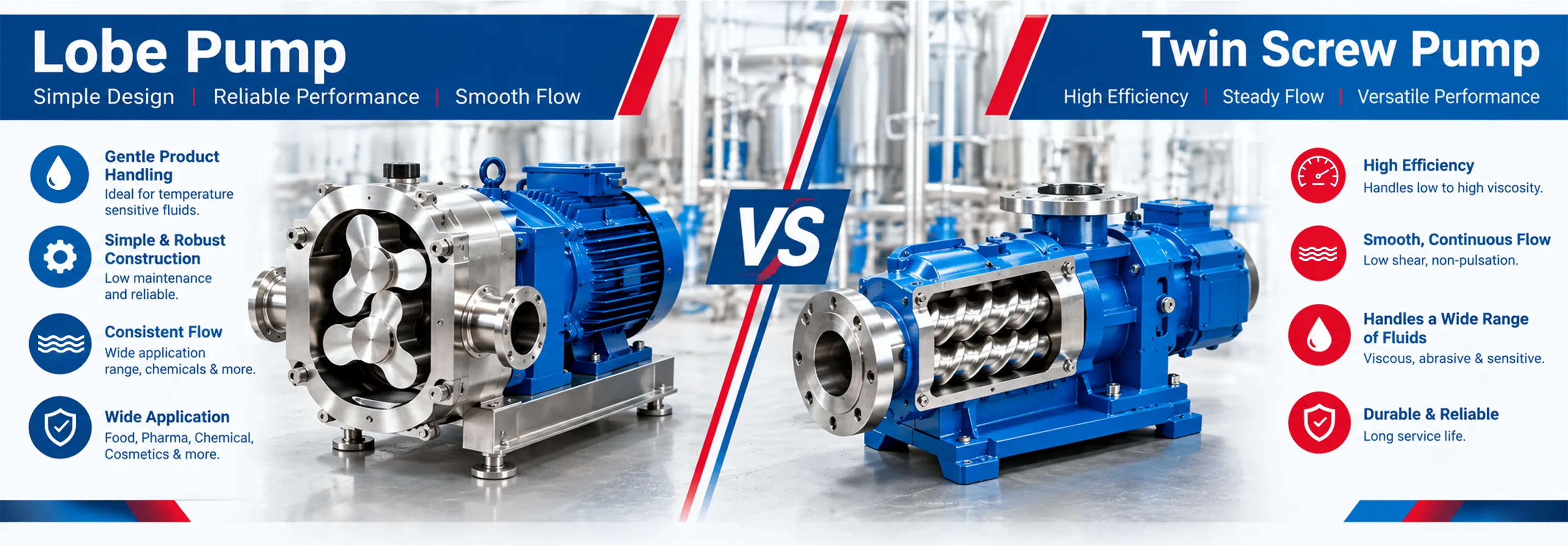
Both pump types can handle high-viscosity fluids when correctly selected.
- Lobe pump: May suit processes transferring a relatively consistent viscous product.
- Twin screw pump: May be advantageous when viscosity varies significantly between products or operating stages.
Always evaluate viscosity at the actual pumping temperature, along with flow rate, differential pressure, and suction conditions.
Which Pump Provides Smoother Flow?Twin screw pumps are commonly selected for low-pulsation transfer. Rotary lobe pumps can also provide relatively smooth flow, depending on rotor geometry and speed.
Where flow variation affects dosing, downstream equipment, or product quality, compare manufacturer performance data at the intended operating point.
Which Pump Is Easier to Maintain?Maintenance depends on the specific design and operating conditions.
- Check rotor or screw wear, seals, bearings, and clearances.
- Review access for inspection and component replacement.
- Compare spare-part availability and service requirements.
- Evaluate cleaning time and the cost of unplanned downtime.
Consider the entire maintenance process instead of assuming that one technology is always easier to maintain.
Which Pump Is Better for Your Industrial Application?
| Industry | Lobe pump | Twin screw pump |
|---|---|---|
| Food and beverage | Viscous products, sauces, creams, and suitable particle-containing foods | Smooth transfer and processes requiring product or operating flexibility |
| Pharmaceutical and cosmetics | Suitable hygienic transfer of creams, gels, and lotions | Hygienic transfer where smooth flow and process flexibility are important |
| Chemical processing | Selected viscous and chemically compatible fluids | Selected fluids requiring flexibility across operating conditions |
| Oil and gas | Selected petroleum and industrial fluid duties | Applications requiring smooth transfer and a suitable operating range |
The correct choice depends on the fluid, pressure, temperature, hygiene requirements, solids content, and pump configuration.
For products such as dairy, sauces, creams, and syrups, consider:
- Product texture and sensitivity.
- Required flow rate and pressure.
- Suspended particles and their size.
- Sanitary materials and surface finish.
- Cleaning-in-place (CIP) and clean-out-of-place (COP) requirements.
For creams, gels, and lotions, evaluate cleanability, drainability, seal compatibility, material certification, and contamination control. Both technologies are available in hygienic designs, but not every model meets every sanitary requirement.
Confirm chemical compatibility, corrosion resistance, temperature limits, pressure ratings, and seal selection. Both technologies may be suitable, depending on the specific fluid and operating conditions.
Evaluate viscosity, suction conditions, pressure, temperature, and the required operating range. Twin screw pumps may be worth considering for suitable low-pulsation applications, while rotary lobe pumps can serve selected duties within their rated limits.
Common Pump Selection Problems and How to Avoid Them
Industrial pump discussions often raise practical questions about flow performance, viscosity, wear, and maintenance. The following checklist translates these concerns into useful troubleshooting steps.
- Restricted suction piping or insufficient inlet pressure.
- Excessive differential pressure or internal slip.
- Incorrect operating speed or pump sizing.
- Viscosity or temperature outside the assumed range.
- Confirm the pump model and performance curve.
- Measure suction and discharge pressures.
- Check fluid temperature and viscosity.
- Verify operating speed and system restrictions.
- Abrasive solids or incompatible materials.
- Incorrect clearances or operation outside rated limits.
- Seal, bearing, or lubrication problems where applicable.
- Inadequate inspection and maintenance.
- Identify solids, fibres, and contaminants in the fluid.
- Select compatible wetted materials and seals.
- Follow the manufacturer's maintenance schedule.
- Monitor unusual noise, vibration, temperature, and flow changes.
Viscosity changes with temperature, formulation, and processing conditions, affecting power demand, inlet filling, internal slip, and flow.
- Provide minimum, normal, and maximum viscosity values.
- Specify operating temperatures and required flow rates.
- Verify performance across the complete operating range.
- Consider twin screw pumps where process flexibility is important, while evaluating rotary lobe pumps against the same requirements.
Cleaning difficulties may arise from retained product, unsuitable pump geometry, or inadequate cleaning procedures.
Before selecting hygienic lobe pumps or twin screw pumps, check:
- Internal design and drainability.
- Wetted materials and surface finish.
- Documented CIP/COP capabilities.
- Seal compatibility and cleaning-fluid requirements.
- Validation and hygiene requirements for the application.
Compare the total cost of ownership, not only the purchase price.
Include:
- Initial equipment and installation costs.
- Energy consumption and operating hours.
- Spare parts and maintenance.
- Cleaning time and product losses.
- Production downtime and service availability.
Factors to Consider Before Selecting a Pump
Use this checklist when evaluating a rotary lobe pump or twin screw pump.
| Selection factor | Information required |
|---|---|
| Flow rate | Minimum, normal, and maximum demand |
| Pressure | Suction pressure and required differential pressure |
| Fluid properties | Viscosity range, density, temperature, and solids |
| Compatibility | Chemical resistance of materials and seals |
| Hygiene | Sanitary design, CIP/COP, and documentation requirements |
| Maintenance | Access, service intervals, and spare-part availability |
| Lifecycle cost | Purchase, energy, maintenance, cleaning, and downtime |
Providing accurate process information helps the pump supplier recommend an appropriate model rather than relying on a general technology comparison.
Why Consider Stephenson Pumps?
Stephenson & Company offers rotary lobe and twin screw pumping solutions for industrial fluid-handling requirements. The appropriate technology depends on the application, fluid properties, and operating conditions.
Choosing the Right Pump for Your ProcessBefore contacting the supplier, prepare:
- Fluid name and composition.
- Minimum, normal, and maximum viscosity.
- Operating temperature and flow rate.
- Suction and discharge pressure.
- Solids content and particle characteristics.
- Hygiene, cleaning, and maintenance requirements.
Explore Stephenson's rotary lobe pump solutions and twin screw pump range for further information.
Frequently Asked Questions
-
What Is the Main Difference Between Rotary Lobe and Twin Screw Pumps?
Rotary lobe pumps use lobed rotors, while twin screw pumps use synchronized helical screws. Both transfer fluid through positive displacement, but their flow characteristics and application suitability differ.
-
Which Pump Is Better for High-Viscosity Fluids?
Both can handle many viscous fluids. The right option depends on viscosity, temperature, pressure, flow rate, suction conditions, and manufacturer performance data.
-
Are Twin Screw Pumps Suitable for Hygienic Applications?
Yes, selected models are designed for hygienic processes. Verify sanitary construction, materials, cleanability, and compliance with the application's requirements.
-
What Are Hygienic Lobe Pumps Used For?
They are used in suitable food, beverage, pharmaceutical, and cosmetic processes where controlled product handling and cleanability are important.
-
What Should You Check Before Replacing an Existing Pump?
Review the current pump model, speed, flow rate, pressure, fluid properties, motor load, and maintenance history. Compare these details with the proposed replacement's performance data.
Key Takeaways: Selecting the Right Pump for Reliable Performance
Rotary lobe and twin screw pumps both provide useful solutions for industrial fluid transfer. Rotary lobe pumps can suit viscous products, selected solids-handling duties, and hygienic applications. Twin screw pumps may offer advantages where low pulsation, changing viscosity, and broader process flexibility are important.
The best selection balances fluid characteristics, flow rate, pressure, temperature, cleaning, maintenance, and total operating costs.